Taking that step, using a white cane
I was under the impression that there was one type of white cane, it was used by people who had very little or no vision and that it was a simple mobility aid to use. Oh how I was wrong! Safe to say I have learnt a great deal since being registered as partially sighted earlier this year.
A white cane is actually very unique to every person, despite coming in all different sizes and materials, this is only the beginning! To start with there are four types of canes:
- Support cane, the best way to describe this cane is to call it a white walking stick. Very much like a symbol cane, it will alert others that they have a visual impairment. The support cane would be used by someone who needs a walking stick as well, but can manage without having a cane to navigate obstacles in their path. A support cane is the only type of cane that you can put weight on to help you walk.
- Symbol cane, this is fairly short in the grand scheme of things and does not touch the floor. It will be white and will be held in front of the individual to alert others that they have a visual impairment. It would not help with navigating obstacles.
- Guide cane, this cane is longer than a symbol cane and will touch the floor when held by the individual- but only just. This type of cane is held diagonally across the body to make other people aware but it also can run along the floor to stop the person walking into things. However, this cane would not be used to run along the floor from left to right.
- Long cane, this is the longest of all canes, and is probably what you think of when someone says they will be using a white cane. It is used to run along the floor from left to right, and will let the individual know if there is anything in the way. It will also help the person navigate kerbs, steps and uneven ground. The long cane is almost up to the person’s shoulder when stood upwards, but this can differ according to preference.
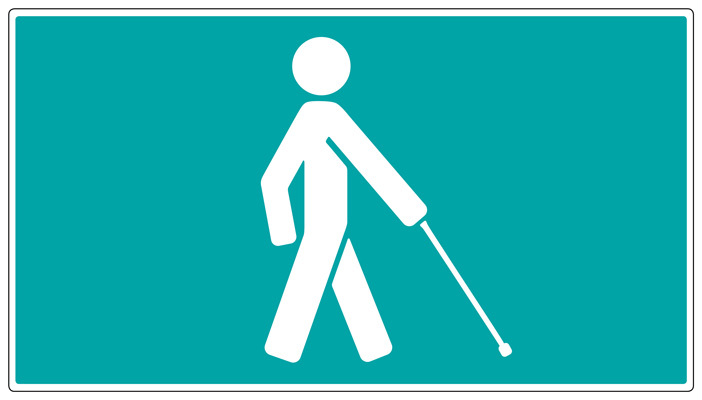 |
| http://www.rnib.org.uk/cane-explained |
Yes, I am not blind, I have low vision and people with low vision can also benefit from using a long cane some of the time. But how do I feel about that?
Yesterday I had my first training session outside with the long cane. I was under the impression that it was fairly straightforward to use, how hard could it be? Well it is a lot harder than it looks! You hold the cane differently depending on whether you are walking on the path or just about to cross the road. The cane is used in different ways whether you are going up or down some stairs and it is heavier than you would expect. When you cross a road you know you have reached the kerb when the cane drops, you then would have the cane at the edge of the road, holding it diagonally across your body until it was safe to cross. With stairs you know the depth of the step depending on how far down the cane drops- I guess this will come with practice. To begin with it felt odd holding the cane, after having 3 years of normally holding a stick it is a fairly big change. Yet I found myself not looking down as often and knew when the pavement changed, I knew when there was a kerb. I did find it tricky to change hand positions all the time and making sure I was rolling the cane far enough to my left, hopefully after my next (and last training session) I will get the hang of it!
Towards the end of the session the rehabilitation officer took the white cane off me and we continued to walk, it was only then that I realised what a difference the cane had made. I instantly started looking down again and found it harder to cross the road. I was in an area that I knew extremely well, so imagine the difference in an area that I didn’t know as well? My cane has now been ordered and my final training session will be in the next few weeks.
I’m taking that step, using a white cane, and hopefully one day I will be okay with that.
2 Comments
Kieran B
Thank you for sharing these stories. I’ve only been partially sighted for a few years and am still refusing to adjust… I think its partly that I don’t picture myself needing it yet and partly that the cane will be accepting the new situation.
Reading your experiences help me relate things and hopefully a better perspective (one small step at a time!
chloetear
Hi Kieran,
Thank you for this. I am sorry to hear you too are new to being partially sighted. I’m glad you were able to find something to relate to though. I appreciate how difficult it can be.